After RealData: Why Manual Analysis Can't Keep Pace With Today's Market
How experienced investors are scaling beyond manual analysis in a speed-driven market
Tips & Guides
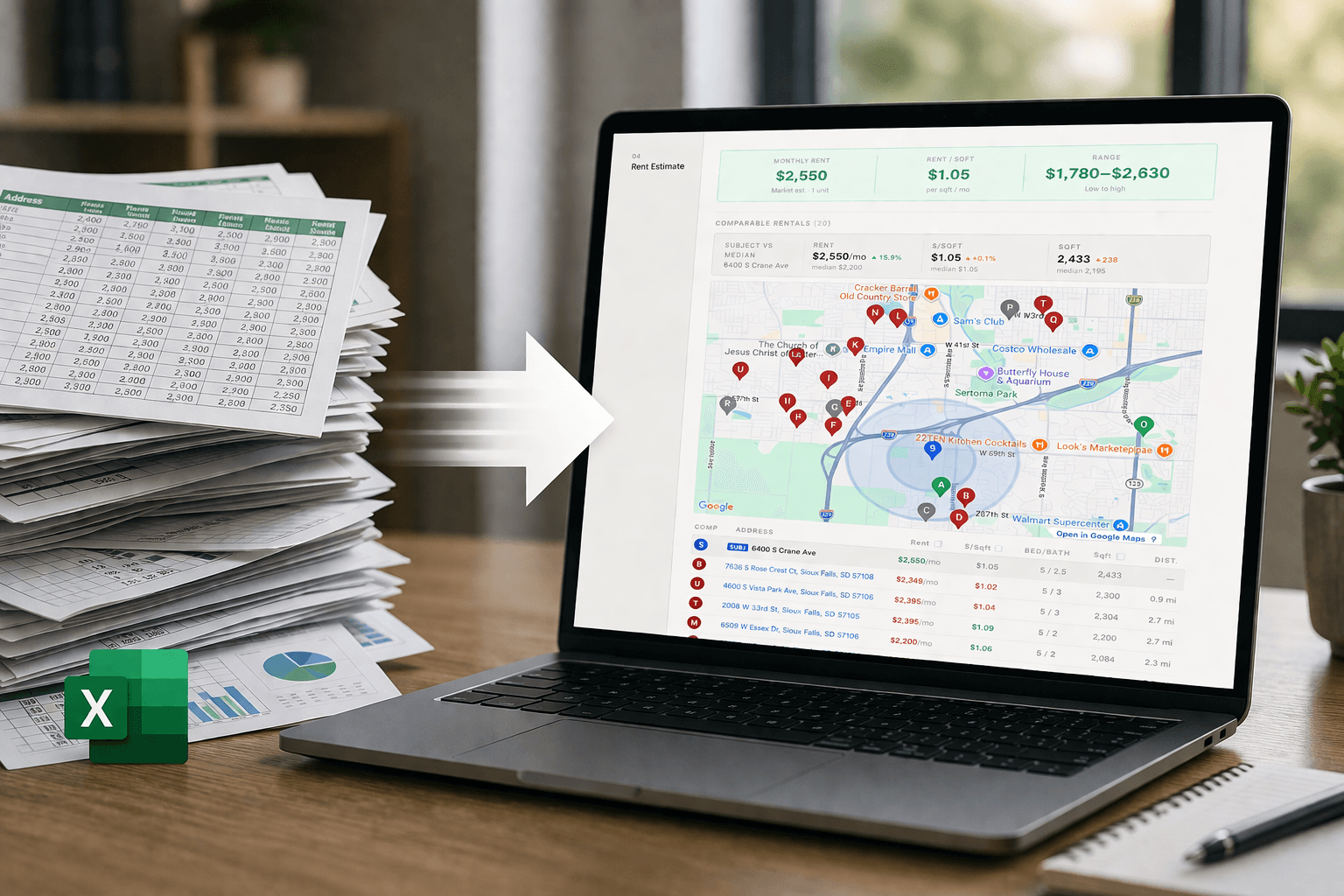
You've got Frank Gallinelli's formulas memorized. You can calculate cap rates in your head and spot a bad deal from three blocks away. But here's the problem: while you're perfecting your analysis of property #47 this month, the investor next door just closed on properties #48, #49, and #50.
RealData's shutdown on April 30th wasn't just the end of 44 years of desktop software excellence — it marked the moment when manual analysis officially became the slow lane.
The Bottleneck Nobody Talks About
Let's be honest about what really happened in your last deal hunt. You probably spent 3-4 hours analyzing a single property that looked promising from the MLS photos. You pulled comparable sales, researched rent rates, built out your cash flow model down to the penny.
The result? The property was overpriced by $40,000 and wouldn't cash flow positive until year seven.
Now multiply that by every property you've analyzed in the past six months. How many hours did you invest in deals that never had a chance?
Insight: The average investor analyzes 23 properties to find one that meets their criteria — and most don't realize this ratio until they track it.
The math was never your problem. You mastered the 1% rule, DSCR calculations, and IRR projections years ago. The real challenge is finding deals worth your time to analyze.
Why the Old Playbook Stopped Working
RealData served us well when markets moved slower and information was harder to access. In 2010, spending a weekend building spreadsheets made sense because deals stayed on the market for 60+ days.
Today's reality looks different:
Then (2010-2020) | Now (2024-2026) |
|---|---|
Average days on market: 65 | Average days on market: 18 |
Manual MLS searches | Automated investor alerts |
Weekend analysis sessions | Same-day decision requirements |
Limited investor competition | Institutional buyers with algorithms |
Time to analyze: luxury | Time to analyze: liability |
You can't compete with speed using tools built for a slower market. That weekend warrior approach? It's leaving money on the table.
So what changed between then and now?
The Analysis Trap That's Costing You Deals
Here's where most experienced investors get stuck: they're optimizing the wrong part of the process. You've got your underwriting down to a science, but you're still sourcing deals like it's 2015.
Think about your last three months. How much time did you spend:
- Building spreadsheets: 40 hours
- Researching comparable sales: 25 hours
- Calling for rent comps: 15 hours
- Actually finding worthwhile deals to analyze: 3 hours
The math doesn't lie. You're spending 95% of your time on analysis and 5% on deal flow.
Meanwhile, investors who've embraced automation are flipping this ratio. They're spending 20% of their time on analysis and 80% on decision-making and execution.
Pro Tip: If you're analyzing more than 5 deals per accepted offer, your deal flow — not your analysis skills — needs work.
What Comes After Desktop Analysis
The investors winning in today's market aren't abandoning analysis — they're automating the grunt work so they can focus on what actually matters: making decisions and taking action.
Here's what the modern workflow looks like:
- Automated daily scans across multiple markets with your criteria
- Pre-analyzed deals delivered with actual tax records and rent comps
- Customizable assumptions so you can stress-test with your own numbers
- Speed to decision because someone else did the initial heavy lifting
You put in your investment criteria once — minimum cash-on-cash return, preferred neighborhoods, maximum purchase price. The system works 24/7 to surface deals that actually fit.
Key example: Instead of spending Tuesday evening analyzing a $180,000 duplex that rents for $1,200/month (and discovering it won't work), you get three pre-screened properties that already meet your 12% cash-on-cash target.
Insight: Successful investors in 2026 measure deal flow velocity, not analysis perfection.
Why Automation Doesn't Replace Your Expertise
Let's clear up the biggest misconception: automated deal finding doesn't make your underwriting skills obsolete. It amplifies them.
You still control the assumptions. You still stress-test the numbers. You still make the final call on neighborhood quality, property condition, and exit strategy.
But you're not wasting time on deals that were never going to work. Every property that hits your inbox has already passed your initial filters.
Think of it this way: you wouldn't manually search every MLS listing in your state to find potential deals. You set search criteria and let technology handle the initial screening. This is the same concept applied to the entire analysis workflow.
The Cylier Advantage
This is exactly why we built Cylier's data-backed, AI-powered investment platform. We're not trying to replace your judgment — we're trying to free up your time so you can focus on the deals that actually matter.
Every morning, you get pre-underwritten opportunities delivered to your inbox. Real county tax data, actual rent comparables, full cash flow models with your assumptions built in. You spend 15 minutes reviewing instead of 3 hours researching.
Insight: The best investors aren't the best analysts anymore — they're the ones who see the most qualified opportunities.
The New Competitive Advantage
Key Takeaways
- Deal flow velocity matters more than analysis perfection — you need to see more qualified opportunities, not perfect your spreadsheet skills
- Automation amplifies expertise rather than replacing it — you still control assumptions and make final decisions
- Time arbitrage is the new competitive edge — while others analyze, you're already moving to the next deal
- Modern tools should deliver pre-screened opportunities with your criteria and assumptions built in
- The bottleneck shifted from math to deal sourcing — most investors are solving yesterday's problem
RealData served its purpose brilliantly for four decades. But markets evolved, and so should your tools. The question isn't whether you can do the math — it's whether you're seeing enough deals worth calculating.
With Cylier's daily automated scans and pre-underwritten opportunities, you'll spend less time in spreadsheets and more time building your portfolio. Because in today's market, the investor who acts fastest usually wins.