Institutional landlords are dumping homes. Don't buy the trap
What to check before buying a home that a big landlord just dumped
Market Insights
You're scrolling listings in Atlanta and a house catches your eye. Four-bed, three-bath, built in 2005, price just dropped $18,000. It's owned by a name you recognize from every rental portfolio headline of the last five years. Your gut says deal. Your gut is wrong more often than you'd think right now.
Since the ROAD to Housing Act became law on July 11, institutional landlords have started unloading single-family rentals at a pace nobody predicted. Listings from the big players jumped from 4,166 in February to over 9,400 homes today. Progress Residential, Invitation Homes, and AMH have all flipped from net buyers to net sellers. VineBrook alone listed 1,900 homes worth roughly $285 million. More than half of those listings, 54 percent, have already taken a price cut.
why the exit is happening in these specific cities
The sell-off isn't random. Atlanta, Dallas-Fort Worth, Phoenix, and Charlotte are the epicenters, and that's not a coincidence. These are the same markets institutions piled into hardest between 2019 and 2022, buying thousands of homes on cheap debt and betting on endless rent growth.
That bet is getting harder to defend. New legislative pressure on institutional ownership, cooling rent growth in Sun Belt markets, and refinancing at today's rates instead of the 3 percent debt they originally underwrote are squeezing the math these funds relied on. When the spreadsheet stops working, you sell, and you sell fast, regardless of what condition the house is actually in.
a price cut is marketing, not underwriting
Here's what a lot of buyers miss: these portfolios weren't built to maximize the value of any single house. They were built to extract cash flow at scale across thousands of doors, with maintenance budgets that assumed a regional facilities team, bulk vendor pricing, and a portfolio-wide tolerance for a certain percentage of units running below standard at any given time.
That model works great for the fund. It does not transfer to you buying one house. A $15,000 price cut on a property that needs a new roof and HVAC system isn't a discount, it's the seller pricing in exactly what they know you're about to find out anyway.
five things to check before you believe the discount
Before you make an offer on anything that came out of an institutional portfolio, run through these checks. Skip any one of them and you're not investing, you're gambling with better marketing copy.
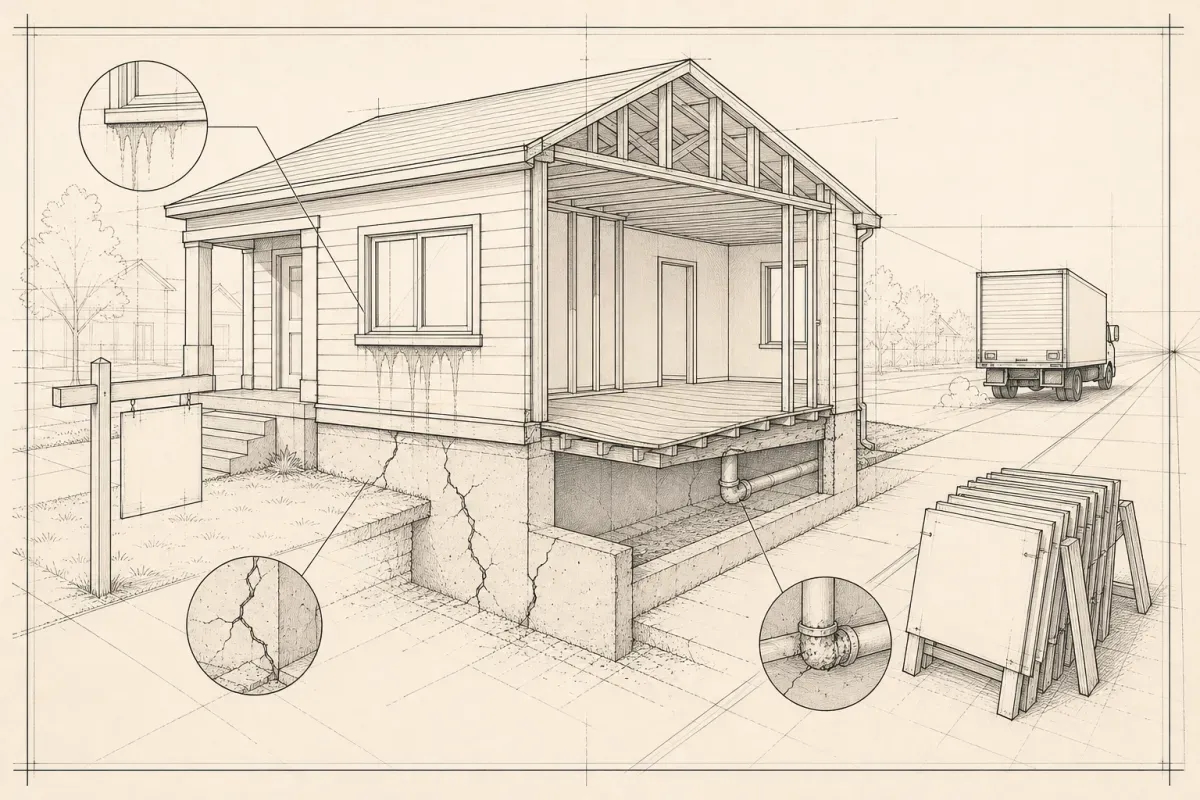
- Get a real inspection focused on deferred maintenance, not a checkbox walkthrough. Ask specifically for HVAC age and remaining life, roof condition and expected replacement window, and any foundation movement or drainage issues. Institutional maintenance budgets are notoriously reactive rather than preventive, so a 14-year-old HVAC system that's still technically running is a liability sitting on borrowed time.
- Pull actual rent comps for that specific block, not the pro forma rent the fund was advertising. If the listing shows a $2,150 monthly rent projection but three comparable homes within half a mile are actually leasing at $1,950, you're underwriting a $200 monthly gap that compounds over a 30-year hold.
- Budget real capex reserves for year one, not the token 5 percent line item most calculators default to. On an ex-institutional single-family home, expect $8,000 to $15,000 in deferred items in the first twelve months if the previous owner held for more than four years, especially on mechanical systems and exterior finishes.
- Check vacancy at the neighborhood level, not the market level. A metro-wide vacancy rate of 5 percent can hide a submarket running closer to 9 percent because institutional exits are concentrated in specific zip codes, flooding local rental supply and softening lease-up timelines exactly where you're buying.
- Stress test the deal at 7 to 7.5 percent, not today's quoted rate. Rates are sitting at 6.55 to 6.85 percent right now, and the Fed's July 28-29 meeting isn't expected to bring a cut. If your cash flow only survives at the rate you locked in and disappears at 7.5 percent, you don't have a deal, you have a bet on monetary policy going your way.
the math that actually separates a deal from a discount
Here's a quick example. Say a VineBrook-owned home in Charlotte lists at $285,000 after a $20,000 price cut from $305,000. The listing pro forma says $2,100 a month in rent. Real comps say $1,900. Your inspection turns up a 16-year-old HVAC and a roof with 3-4 years of life left, adding $12,000 to your year-one reserve.
Run that at 7 percent on a 30-year loan with 20 percent down and your monthly payment lands around $1,520 before taxes, insurance, and the capex reserve you just built in. Suddenly a $20,000 discount looks a lot less generous once you've priced in the real rent and the real repair bill. That's not a bad deal necessarily, but it's a completely different deal than the one advertised.
the deals are real, most investors just can't find them
BiggerPockets' Q3 Investor Pulse survey found that finding good deals is now the number one challenge investors report, ahead of financing and even interest rates themselves. That's the irony sitting in plain sight right now. There are more single-family rentals hitting the market than at any point in years, and most investors still can't tell a genuine opportunity from a fund quietly offloading its worst-performing assets.
The sell-off is creating real openings in Atlanta, DFW, Phoenix, and Charlotte for buyers willing to actually underwrite each property instead of trusting the sticker price. That takes pulling real rent comps, running honest vacancy numbers at the block level, and stress testing at rates that are 50 to 75 basis points higher than what's quoted today.
That's exactly the kind of grinding, line-by-line analysis that a good AI-driven property report can compress into minutes instead of days, flagging deferred maintenance risk, comparing the seller's pro forma against actual local rents, and running the deal at multiple rate scenarios before you ever schedule a showing. With over 9,400 institutional listings on the market and more coming, the next few months will separate investors who bought a discount from investors who bought a deal. Make sure you know which one you're getting before you sign anything.